
Lowering the Flag of our Fathers

It is daring to believe that a pastor could look like me: a non-passable, six foot tall, transgender woman with a deep voice who looks fine in a sunflower dress. This is not the normative picture of leadership in the Christian tradition. The gospels lift up “the twelve” male disciples of Jesus while marginalizing the role of women, although women were the ones present at the foot of the cross and proclaimed the first Easter sermon. Scholar Elizabeth Schrader has demonstrated how patriarchal editorial revision altered scripture and erased the leadership of Mary Magdalene. The Apostle Paul instructed the church in Corinth that “women should be silent in the churches. For they are not permitted to speak, but should be subordinate, as the law also says.” (1 Cor 14:34)
With this license to discriminate, leadership of the church has been patriarchal. I grew up in a denomination, Lutheran Church—Missouri Synod, where women are only aloud to teach children and prepare meals. Women are not only prohibited from serving as clergy, but even serving as lay leaders in the church. My father, an elder of the church in which I was baptized and confirmed, recently offered a solution to a shortage of ushers. He proposed that couples could usher. This idea was met by condemnation from the church as women are not allowed to usher. Who does a woman think she is to hand someone a bulletin and lead them to a pew? As a result of these millennia of discrimination, despite being a child of a church going family, I never met a female pastor until I enlisted in the Air Force.
It would be another 20 years before I met an openly identifying queer pastor. In my first semester of seminary at Brite Divinity School I heard Dr. Steven Sprinkle preach the only sermon whose title I remember, “Shadrach, Meshach, Abednego and us Queer Ass Folk.” I was 39 years old the first time I heard a gay man preach. Moreover, this is the first time I ever heard from the pulpit that who I am as a queer person is good, that queer people have a gift to bring. In the first four decades of my life the pastors I knew (overwhelmingly white, cisgender, heterosexual, men) condemned people like me. How could I imagine openly serving as a queer pastor when I had been told these pieces of me are corrupt?
Not only was the spiritual foundation given to me patriarchal, it was disembodied. Dualism of mind and body is not a new concept. The Platonic view of the potential goodness of the mind or soul against the badness of the body has long shaped our view of ourselves. Within Christianity Paul’s characterization of the flesh continues that dualism, “To set the mind on the flesh is death, but to set the mind on the Spirit is life and peace. For this reason the mind that is set on the flesh is hostile to God; it does not submit to God’s law—indeed it cannot, and those who are in the flesh cannot please God.” (Rom 8:6-7) While one could argue that Paul is not talking about the human body when he uses the term “in the flesh”, Christian teaching has espoused the idea of the sinful body over the eternal soul.
For me, this negative view, taught by the church of my youth, of the body compounded how I felt about myself. As my body changed through puberty, I felt uncomfortable with who I became. The hair on my body felt gross. The deepness of my voice foreign. The reflection in the mirror a stranger. The church telling me that my body was corrupt and bad confirmed how I already felt about myself.
Author Shannon Kearns, director of QueerTheology, shared in an interview the spiritual impact of gender roles imposed on him being assigned female at birth:
I needed to be small and put everyone else first. Everyone else’s needs were more important than my own. Specifically because everyone assumed I was female. I was expected to be submissive, I was expected to not be a leader. I was expected to meet other people’s needs. I was expected to be quiet and behave in ways that people who they assumed were boys were not brought up in the same thing.
At the same time, faith was presented as an intellectual pursuit. The culmination of confirmation in being quizzed in front of the congregation on Martin Luther’s Large and Small Catechisms and the Bible. Faith seemed to be more about believing the right things than doing the right things, confessing the creeds over living the life.
The inherent message was that if you believe the right things you will go to heaven and receive a new body, replacing this sinful, broken shell.
A disembodied spirituality matured in to disembodied leadership. A leader looked like a confident, extroverted, man like my father and pastor, so I put on all of those masks. But the masks were inauthentic and untenable.
Know thy Queer Self
The first step for anyone to lead from a place of an authentic spiritual grounding is to know yourself. The dominant culture tries to put everyone in predictable roles based on gender, race, class, etc…. From Myers-Briggs to spiritual gifts inventories, a plethora of resources exist to help discern one’s place. As a pastor looking to give opportunities to church member for them to grow, I am guided by the Howard Thurman quote, ““Don’t ask yourself what the world needs. Ask yourself what makes you come alive, and go do that, because what the world needs is people who have come alive.” Rather than shoe horning people in to committees to fill seats, I seek to connect people’s passions and abilities (who they authentically are) with opportunities.
One resource I have found helpful for faith leaders is the enneagram. While the personality typography of the enneagram has been used in business settings, it has also been used by spiritual leaders such as Richard Rohr and Cynthia Bourgeault to help people understand the motivations and shadow side they operate from. Using myself as an example, I am a two on the nine point enneagram scale, characterized as a helper. I find purpose in helping others while my shadow side is the need for affirmation that comes from that. This is consistent with my leadership style. I am a person who seeks to build consensus and often leads from behind. I want to help people live in to their fullness, let them blossom, and step back.
Since knowing one’s self is the essential step to authentic leadership, queer people have an advantage over cisgender people. Us “Queer Ass Folk” have had to wrestle with who we are. Like Jacob wrestling with the angel, I have refused to let go of God until I received a new name. We have had to wrestle with our own internal identity and how we express that in the world. For me as a faith leader there is often a balance between the authentic expression of myself and what feels safe in the contexts around me. Nonetheless, the process that queer people go through to interrogate who they are, and how they live their lives amongst the dominant culture, result in a developed, known authenticity that many people have not developed. This authenticity is a gift that queer people can bring in to the world. We know who we are, and can stand tall in our four inch heels, operating from our queer foundation.
Raising a New Flag
The process of deconstruction brings with it the opportunity for reconstruction. Decolonizing a cisgender, heteronormative spiritual leadership style creates space for the blossoming of a vibrant queer expression. But like a gardener tilling soil, creation takes intention and work. Here are several steps toward embodying a distinctive, transgender leadership.

Chosen Family
A full, spiritual life is not one that can be lived in isolation. As Dr Martin Luther King wrote in his Letter from a Birmingham Jail, “We are caught in an inescapable network of mutuality, tied in a single garment of destiny.” While this resource previously mentioned the negative views of the body espoused by the Apostle Paul, Paul also talked about the interconnectedness of the body of Christ, that followers of Christ are all members of one body. (1 Cor 12)
While transgender people cannot isolate from the dominant culture (although that often sounds appealing), it is essential to build relationships creating a chosen family. Biological family reactions to queer people “coming out” varies. While stories of rejection are prevalent, there are families who support and celebrate their transgender members. One’s who, like Paul, live out the truth that we all need each other. To paraphrase Paul, cisgender eyes cannot look down at the painted nails of a transgender hand and say I have no need of you. We all need each other.
At the same time, we also need safe spaces, with people like us, where we can fully let our wigged hair down and breathe. In queer communities this is often referred to as chosen family. The term “Chosen Family” was coined by Kath Weston in her book, “Families We Chose: Lesbian, Gays, Kinship.” Through the lens of the AIDS pandemic, Weston outlines how gay families care for each other, accompany each other, and nurture one another.
One of the partner organizations I work with is the Black Queer & Intersectional Collective (BQIC). Not only does BQIC do advocacy work to protect the rights of queer people, but weekly hands out health kits in front of a local coffee shop. Funds are available for black, queer people to receive assistance with rent and utilities. Every October a “Community Pride” event is held to offer a full range of resources and the day culminates with a celebration at a local lesbian owned bar. In all of this, safe relationships built on trust and mutuality are formed. People are not only given resources to survive but are celebrated so that they can thrive.
Whether one’s family of origin is affirming or rejecting of gender, it is essential to grow one’s chosen family. It is in this safe space that our roots can grow deeper and we can flourish in our strength.
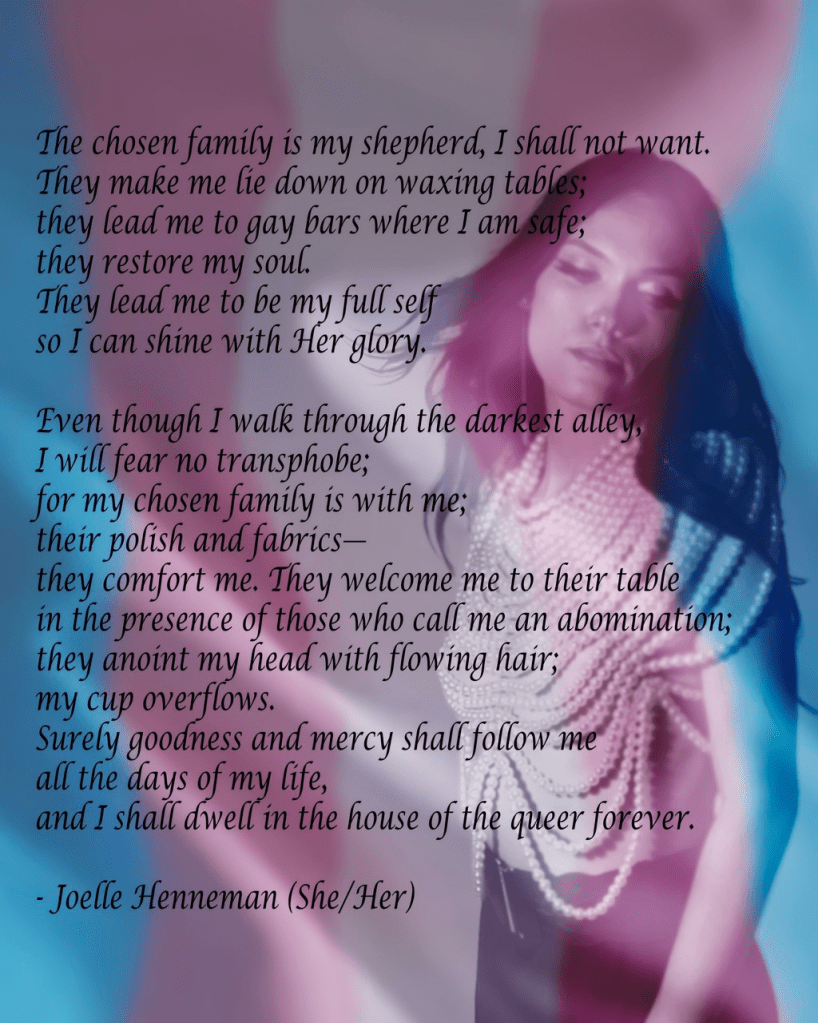
In May 2022, I spoke at a rally opposing proposed legislation in the Ohio state government that would’ve restricted healthcare access for transgender youth. In support of this legislation, some Christian pastors vocally condemned transgender people. In order to offer a different perspective from a faith leader, I rewrote the words of the 23d Psalm and proclaimed them through a megaphone outside the Ohio Statehouse.
We Can Be Sheroes
Role models play an important part in human development. Children model the behavior of their parents. Media and culture influence all of us. Growing up in the 1970s and 1980s, a lack of transgender role models left me without a connection to hold on to. I knew I did not feel at home in my skin, but had no reference to interpret that. Without any other point of comparison, I assumed this discomfort was normal, that everyone felt this way. I didn’t know different gender identities or expressions existed–those terms had not even been coined yet.
With the transgender population making up a small minority, it is essential that we actively seek out and surround ourselves with transgender role models. When we intentionally look, they are all around us. There is gender fluidity in the Ethiopian eunuch who asks Peter, “What is it to prevent me from being baptized.” (Acts 8:36) From medieval art to American Civil War history to Welsh rebellions, history is filled with the often under-told stories of transgender people.
The benefit of living in the 21st Century is that we don’t have to look hard to find transgender role models in popular culture. From Elliot Page to Laverne Cox, transgender people are beginning to be lifted up. Just in the year 2022, music artists such as Ethel Cain, quinn, and Ezra Furman have put out some of the most notable albums of the year. June Jones sings of the transgender experience in her song Hoodie Girl, “I want to be the most beautiful woman that you’ve ever seen/But if I can’t be her I’ll settle for being happy.”
One area without an abundance of public transgender representation is in spiritual leadership. People like Pastor Paula Stone Williams and authors like Austen Hartke and Shannon Kearns are known within the small community. The tone of news stories about clergy coming out, like Pastor Junia Joplin, reflects the anomaly of out transgender pastors. The more that we can embrace and express our transgender spiritual leadership, the more we can be role models for others.
Reading Scripture with Shadowed Eyes
One of the most transformative steps in creating an authentic, transgender spiritual leadership style is learning to read scripture with new eyes. This is not limited to either searching scripture for validation or combating clobber passages. Rather, it is reading scripture from a distinctive transgender hermeneutic. For me as a transgender woman, this results in scripture coming alive as it is no longer the “old, old story of Jesus and his love” but the perichoresis of a God ever at work in creation. When I engage with scripture from all that I am, I see God through the lens of my glitter eyeshadow pallet.
When reading scripture, ask yourself how does my experience as a transgender person connect with this scripture? Where do I see my queer self in this story? What word of hope and liberation is God offering to me? How do the biblical stories of transformation connect with my transitions? How do scriptural promises of life connect with how you have found life in your gender expression?
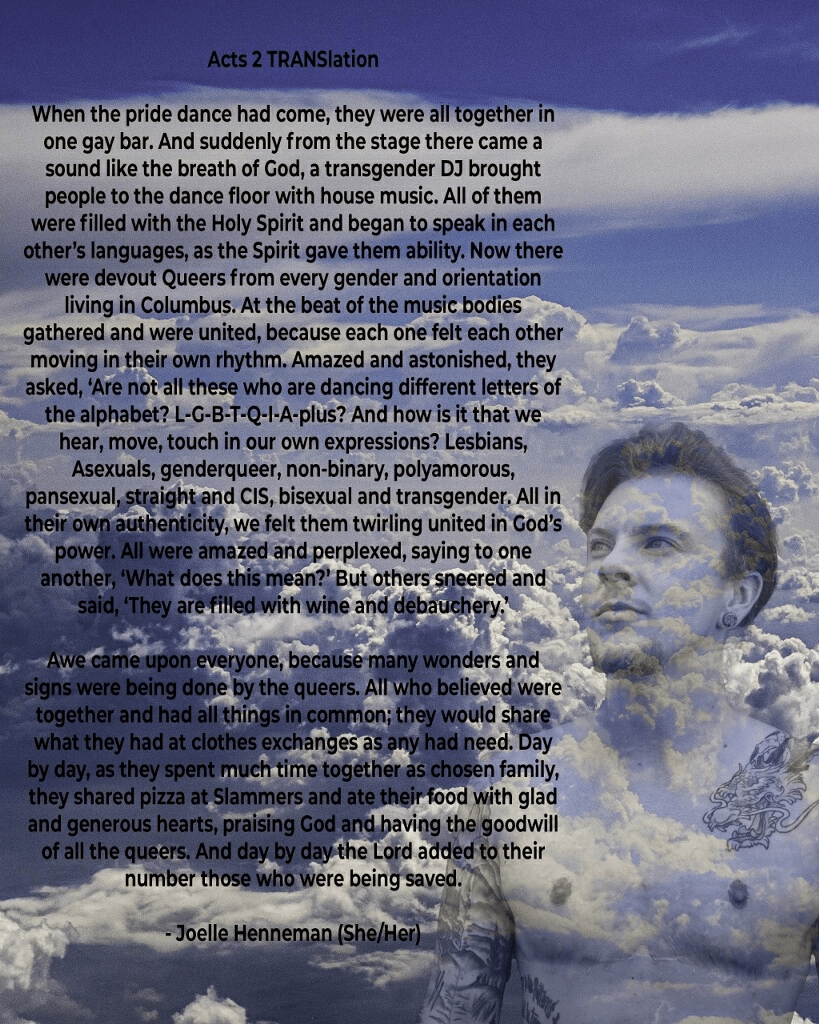
Journaling is one common way of reflecting on scripture. I have combined journaling with creative writing to reimagine how scripture can be placed in a modern context of time, place, and gender. The following page is a poster that photographer Vincent-Natasha Gay made of my TRANSlation of Acts, Chapter 2.
Embody Your Prayer Life
Gender dysphoria can easily lead to a sense of disembodiment. If I feel uncomfortable with the skin I am in, it is difficult to stand in a place of leadership. At the same time that we feel disembodied in our gender, many of the prayer practices we inherited are disembodied. The pattern of prayer I was taught was to fold my hands, close my eyes, and lower my head. As a person not at home in her body, this process of closing my eyes felt like an escape from the body that made me uncomfortable. My prayer life did not connect me with my full authentic self, it further separated who I was from my physical expression.
As transgender people, we often reclaim our place in the world by changing names, pronouns, or wardrobe. In the same way, one method of transitioning our spiritual leadership is by reclaiming our bodies in prayer. We don’t need to close our eyes and separate our mind from our spirit, but open our eyes and see our goodness. Explore embodied prayer practices such as labyrinths, yoga, or walking in nature. Recognize that prayer is not limited to folding our hands and giving God our to-do list, but like Brother Lawrence washing dishes, prayer can happen in any time and place that we are aware of the presence of God. For me, my most prayerful moment comes while sitting at my vanity, doing my makeup, and bringing out the beauty of the divine feminine God created within me. From this place, I can then walk out in to the world in my four-inch heels and embody my transgender spiritual leadership.
Leading From a TRANSpirituality
Authenticity is an essential aspect of leadership, but what difference does embodying a transgender spirituality make? Other than making us feel more comfortable in our own skin (which is important in itself) how does it manifest itself in leadership styles that look different from the dominant, cisgender culture? What gifts can a transgender leader bring to an organization that are unique?
In an interview with Austen Hartke, founder and director of Transmission Ministry Collective, he shared:
One of the things we are intentionally trying to do with TMC, and the reason we call it Transmission Ministry Collective, is we want it to be more of a collective decision making process. Led by the community and not by one specific person. One of the things we put in our by-laws, right from the beginning is that TMC has a successive leadership plan. The executive director can only be in that position for a maximum of five years. We never wanted this to be somebody’s baby. This is not mine. In some ways it’s my baby because I started it, This is not an organization that should be dependent on me as some type of cult of personality.
As we create these communities, as we create these resources, how do we make sure this is something owned by the community and not something that is a cult of personality for any one person.
As transgender people we have gifts to bring our communities. While so many news reports about us focus on whether or not transgender people should compete in sports or at what age our children should have access to healthcare, we are not a political issue, we are a people with unique gifts to bring. Just as there are many types of gender identity and expression, there are many types of transgender leadership styles. It is not the intent of this brochure to outline one particular leadership style, but to invite us as transgender people to do the spiritual work so that we can lead from a place of authenticity. While our experiences are different, we have shared unique gifts as people who have been through an intentional process of self-discovery, a people who have experienced transformation, and a people who have shown courage in a dominant culture that can be threatening and unaccepting. In the face of all of that, we have stood tall in who we are. Now is our opportunity to lead others in finding life, and finding it abundantly, in all of its diversity.
 transpreacher.com