Finding Yourself
Social Media is an important tool for gender diverse people to explore identity and develop expression. The anonymity of different platforms and accounts allows people to do research, make social connections, and develop an authentic name and presentation. A University of Michigan study noted, “Trans users work within the frames of the social media sites they are on to express their identities, and often find ways to explore gender identity with the technology available to them, such as by creating online identities with different gender expressions.”

As I began to explore my gender identity, I used anonymous social media accounts to connect with other transgender people and explore my appearance. These connections served in an important role in shaping my own personal identity. Online communities are often the first places where people can dress authentically, learn from other people’s transitions, and share their names.
While the opportunity for formation of identity through social media is important, it also comes with its own obstacles. One is the comparison game. Many of the most popular transgender people on social media are young, wealthy, and have access to the best medical care. This can lead to a pressure that to be a “real” transgender person one has to conform to binary standards of appearance. Second, social media often presents the narrative that transgender people will feel better post-transition. While this is often the case, it can lead to an expectation that transition will be the solution to all of life’s problems. People transition not to feel better because it is who they are. Living authentically is important to one’s mental health, but not the answer to every problem. Lastly, the structure of social media platforms, reliance on legal forms of identification, and sharing of liked pages has resulted in the inadvertent outing of people leading to broken relationships and lost jobs.
While a part of my identity is that of a transgender woman, another significant part of my identity is that of a pastor. All day long, I am called on by people saying “Hey, pastor!” Reconciling gender and faith are an essential undertaking for anyone I saw, but made more imperative when it is ones profession. My gender transition has been an opportunity for the United Methodist Church for All People, which I serve, to more fully live in to its name and for people to develop a broader understanding of who the neighbor is that Jesus calls us to love. Melissa Wilcox writes, “Considering gender identity to be a divine calling makes being transgender intrinsically good and holy.”
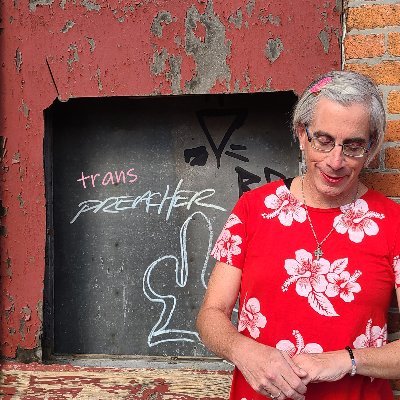
All forms of diversity are a gift to the church. The mosaic of multiple expressions provide a broader perspective on the divine. Social media served as an important platform to develop my gifts and voice as a transgender woman who is a pastor. I started a TransPreacher blog in 2021 as a platform to begin to explore what the proclamation of the gospel would sound like from transgender lips. From this platform I preached sermons with a transgender hermeneutic, interpreted scripture from a new perspective, and developed my voice.
For example, in November 2022, I published a video sermon offering a transgender interpretation on Isaiah 65 titled “New Creation.” Dressed in feminine attire before I was fully out to the church, I could speak more as my authentic self. I asked where God’s new creation is happening in a world that is still filled with injustice, violence, and poverty 2,500 years after Isaiah’s vision. I offered that the continual act of creation is seen in transgender people, “Our lives are a witness to a God who is at work bringing a new creation… God is creating something new in me as a transgender woman… bringing something more beautiful and alive in me… God’s new creation starts with us. We as transgender people have a particular testimony, a particular witness.” Through social media, transgender people can develop their identity and expression as a new creation.
In the Public Digital Square
Over the next two years the blog site grew in engagement and content as the number of people I was out to increased; and, as I participated in statewide social justice advocacy, centered around anti-trans legislation. In June 2023, I was invited to preach at the first in-person Reconciling Ministries pride worship service in Central Ohio since COVID. The sermon I preached “We’ve Never Done It This Way Before,” ended with the argument that the kingdom of God comes when we do new work in new ways. The resounding response I received to this sermon made me realize that the audience for my messaging was broader than what I initially envisioned. It was not only other transgender people of faith who were interested in what I had to say, but the greater church yearning for new ways of being.
Coupling my own increased public presence with studies at Pacific School of Religion, resulted in the creation of a TransPreacher social media presence on Instagram, Facebook, and Twitter/X in June 2023. At this point, I thought queer people would make up the bulk of my followers and shaped content speaking specifically to LGBTQ+ folk. These messages centered on lifting up the goodness and giftedness of diverse voices. I posted my first vlog on Independence Day, July 4, 2023. In response to a negative Supreme Court decision and comments by Vice President Mike Pence, I stated:
We are free to exist and our existence is a powerful statement that empowers the people around us to stand in their own strength and their own authenticity. As queer people we are free in Christ, we are free indeed… We queer people are free from the condemnation of people who want to misuse scripture to condemn us… We queer people do have freedom and independence when other people turn away from us or judge us. We queer people are free to shine the light of Christ that uniquely radiates from us in our pride rainbows. We queer people are free and we are free indeed.
I quickly discovered that a much broader audience was interested in hearing a transgender voice. As I continued to produce short-form videos on social media, my perspective grew to include issues of scripture, faith, theology, culture, current events, and politics. Since that time, over the next two years I published more than 150 videos that reached thousands of people. These one to two minute videos brought a once silent voice in the faith community to a public and accessible place. As an example of developing broader messaging, on March 31, 2024, Easter Sunday and Transgender Day of Visibility, I said on video “Today we not only celebrate Jesus who is transformed, but God’s work of transformation in all of us… Be you, whether you are cis or trans or anywhere in between. Celebrate who you are. You are a child of God. You are beautifully and wonderfully made. Be you.” These comments to a broader audience illustrate the growing range of the TransPreacher platform.
Rev. Dr. Sarah TevisTownes, a United Church of Christ pastor in Albuquerque, New Mexico, has demonstrated the potential of using social media through her TikTok and Instagram profiles. Her accounts, “Disorganized Religion,” have garnered hundreds of thousands of followers with over one million views per month. She effectively uses humor to challenge the church to decolonize its practices. In addition to the voice she has developed in her own media, she also works with faith leaders to invite others to bring their voice to social media. In a series of video trainings, TevisTownes outlines steps to build an effective social media presence with topics that include: Find Your “Why”, Lighting, Find Your Audience, What Should You Post, Script Writing, Tips for Going Viral, Using a Green Screen, Captions and Accessibility, Saving Time with Series, How Often Should You Post, Going Viral and Keeping Your Job, What to Wear, Using Hashtags, Dialog and Charecters, Using Teleprompters, Responding to Comments, and Dealing with Trolls. A faith leader looking to develop a social media presence should explore these resources.
Creating Change
Social media has the potential to give voice to those who have been historically silenced by the church. From proof-texted interpretations of scripture to religious restrictions, the Christian church has historically been led by straight, cis-gender white men. Patriarchy has intentionally silenced voices of women, people of color, disabled, and LGBT+ populations. In contrast, social media provides a platform for all voices to be heard.
While this potential exists, the structures of social media do not automatically center marginalized voices. In fact, algorithms privilege already dominant voices. However, intentional usage of social media can create change through the outward expression of LGBT+ profiles and in the content created. Stefanie Duguay writes:
…queer movements can and do appropriate, repurpose, and subvert the platform for worldmaking purposes. The queer potential to realize utopic futures, ones unconstrained by heteronormativity and cisnormativity, can be realized in moments–as short as a looping video… Through queer methodologies, and digital methods queered, we can notice how TikTok is implicated in these moments and becomes a tool of queer futurity.
Despite obstacles that privilege the already powerful, social media offers transgender faith leaders the forum in which to share stories and provide a human face in response to mischaracterizations and dehumanization. Every marginalized person who posts on social media contributes a voice to the public conversation outside of the dominant culture. As such, my TransPreacher platform, or any individual voice, is more than a lone voice crying in the wilderness, but joins with the chorus of other marginalized voices to challenge existing systems rooted in patriarchy, colonialism, and white supremacy.
While transgender voices have been historically marginalized, as a content creator myself, I recognize the privilege I am given as a white person. While I have experienced prejudice as a transgender woman, I still am given power because of the color of my skin. From this power, I strive to use my platform to center the voices of people of color. My posts frequently point to the work of Black leaders and the intersectionality of gender and race. I often cite Black leaders such as Audre Lorde, Howard Thurman, and Angela Davis. I also use my platform to often highlight that the most vulnerable people in our country today–young, Black, transgender woman. With so much of social media dominated by white voices, it is imperative that we use our privilege to center people of color. To pretend that social media is colorblind results in perpetuating systems of oppression.
One tactic for increasing voice on social media is amplification. Instead of joining one transgender voice with others, joining the voices of marginalized groups together against systems of power. This intersectional use of social media “challenges histories of trans misrepresentation and ongoing violence through an amplification of individual users voices that, within the collective force of the hashtag, signals how shared experiences of love, support, and solidarity transcend institutional and material marginalization.”
However, amplification is not a guaranteed process that results in transgender voices being heard and systems of equity achieved. Many traditional and limiting societal forces remain in place amongst social media contexts. For example, social media will give greater weight to the voices of celebrities such as Caitlin Jenner over a non-celebrity like me. Also, media often speaks on behalf of transgender people instead of giving voice to transgender people.
Therefore, it is important for queer faith leaders using social media to speak in their own ways and from their unique experiences, voices, and identities. It can be easy for marginalized voices to adapt the language of their oppressors and spend a lot of energy in a defensive posture. This results in the larger culture speaking on behalf of transgender people and portraying them as entitled and complaining.
Instead of being spoken about, social media gives transgender faith leaders the opportunity to speak for themselves. With this opportunity, gender diverse people offer fresh and creative expressions that not only push against limitations, but create new spaces for diverse people to shine, “Marginalized groups, such as trans communities, have historically been denied the tools and spaces to actualize voice within mainstream media. However, those groups have found creative ways to express their voices, particularly in the realm of activism.”
Self-Care
While social media can be used as a tool to offer a fresh transgender gender voice to issues of faith, politics, and culture, the vulnerability of digital communication can lead to harm perpetuated against gender diverse people. Like all social media users, queer folk use multiple platforms to find jobs, housing, and build community. The anonymity of secondary accounts and private spaces provide the opportunity for understanding one’s own gender identity and expression. However, the increased reliance on social media also provides increased exposure to cyberbullying. While cyberbullying can happen to anyone, “female and genderqueer young people are bullied more often and differently than males.”
The same social media tools that have been used to build community amongst queer people have also been used by anti-LGBT groups to find and target queer people of faith. In 2017, nuns of the Siena Retreat Center outside Milwaukee, Wisconsin had to hire security to protect an LGBT gathering that had been taking place without incident for 25 years. Hate groups used social media to organize and interrupt the annual gathering. According to the Catholic advocacy group, New Ways ministries, social media has been used to find, target, and expose LGBT faith leaders, resulting in 80 church leaders losing their jobs by 2018.
During the United Methodist General Conference held in Charlotte, NC in April and May 2024, I served on the communications team of the Love Your Neighbor Coalition, generating social media content. On April 29, 2024 I interviewed Rev David Meredith, chair of the board of Reconciling Ministries, and a pastor who was brought up on charges for marrying his partner of 30 years. Meredith talked about his hope that this General Conference would bring change after 40 years of LGBT+ advocacy work. He said he engaged in this work “Not because I expected the church to really make the change then, but because I could not stay in the United Methodist Church if I did not try to make it a better place. A holy place. I can taste it, I can smell it, I can feel it in my bones.” While this was a rich and vulnerable and historic conversation that reached over 8,000 views on Facebook alone, it was also responded to with hateful comments. Staff of the Love Your Neighbor coalition informed me that they were removing bigoted comments for me so I would not have to see them.

In addition to producing social media content for the coalition, I posted content to my own TransPreacher platform and experienced a spike in views and connections. While receiving many comments of affirmation, there also came hateful comments of judgment. For example, a video I created, talking about The United Methodist Church voting to be in full communion with the Episcopal Church, got over 1,300 views. However, comments on this video told me that I was possessed by a demonic spirit, am the picture of mental illness, and that I am going to burn in hell because I am transgender. With this increased attention, my TransPreacher blog was the victim of spam attacks and temporarily shut down.
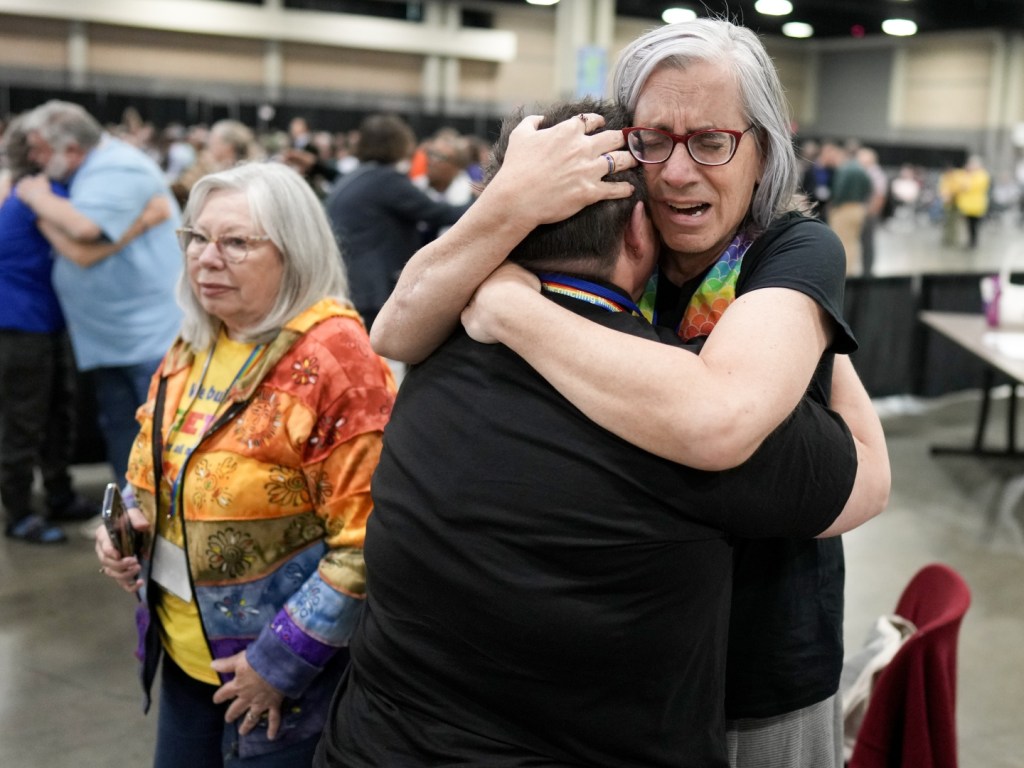
On an even larger scale, immediately after the General Conference removed restrictions on ordination for LGBTQ+ clergy, the Associated Press took a picture of me crying while hugging Rev Angie Cox—a friend denied ordination six times because she is an out, lesbian married to a woman. The picture got picked up and published by news organizations around the country including NBC, the Wall Street Journal, and CNN. My own TransPreacher Instagram recorded more than 5,800 plays for this one post, a fraction of the national attention. While congratulations poured in from around the country, the comments culminated with one person calling me “disgusting” and another person stating, “so they aren’t a church of God then.”
After this publicity, I received an anti-LGBT Bible tract in the mail, delivered to my home. The tract, titled “Doom Town” described homosexuals as worthy of death, by misinterpreting the story of Sodom and Gomorrah. This felt incredibly invasive as someone did not only target me professionally, but went through the effort to find my personal, home address and physically mail hateful content to me. My home is my safe place where I can relax and feel safe within a cis-gender world. That safety was violated.
Bigoted comments are no surprise to users of social media. But for vulnerable people generating content, an awareness and plan of self-care is necessary. The question is not if queer people will be targeted, but when. The work of transgender faith leaders is changing the world. We are challenging society-wide binary understandings of gender; and, pushing the church to be a more inclusive space. These changes will get resistance.
However, before generating social media content, particularly from a marginalized position, one must consider how to practice self-care in the face of threats, bigotry, and hatred. A content generator needs to ask themselves: what support systems are in place before harassment happens? How will you react and respond? Will you reply to trolls? From my experience, it is better to ignore, block, and report abusive comments than it is to try and talk someone out of their bigotry. However these situations are handled, it is important to think through how they will be handled before finding one’s self in a vulnerable situation and in order to maintain mental and emotional health. With these protections, social media is a powerful tool that can be used to develop a queer identity and offer new perspectives to faith communities.
 transpreacher.com