
Preached June 29, 2025 at Unifour Church, Newton NC
Psalm 139:13-18
My name is Joelle Henneman, my pronouns are she/her, I am the pastor of the United Methodist Church for All People, and my favorite band is Public Enemy.
Public Enemy released a song almost 40 years called “Don’t Believe the hype.” In this song Chuck D raps:

The minute they see me, fear me
I’m the epitome, a public enemy
Used, abused without clues
I refused to blow a fuse
They even had it on the news
Don’t believe the hype
For too long, we as LGBTQIA+ people have believed the hype.
The hype that something was wrong with us. The hype that we are sinful. The hype that we are condemned.
I grew up in a very conservative church that filled me with shame for who I am. As I grew in to puberty, hair started to grow on my body. My voice got deep. I hated seeing my reflection in the mirror because it did not reflect me. I was becoming something on the outside that never matched who God created me to be on the inside.
For decades I wrestled with my own self. Why would God create me like this, if who I am at the depth of my being was wrong? Why would God create me like this, when the church told me that living my truth would be a sin?
I literally tried to pray who I am away. There are churches who try to pray the gay away, I tried to pray the me away. But fortunately God did not answer that prayer in the way I was asking for.
Maybe God was saying to me: don’t believe the hype.
A few years ago I read a book that had a quote that said “cis-gender boys are just happy being boys.” I was 50 years old when I learned this. Why didn’t anyone ever tell me that? I thought everyone was as miserable as me. I thought all boys hated the changes happening in their body.
I didn’t know my experience was different from anyone else because I couldn’t say how I felt. In a family and a community and a church that said who I am is a sin, I did not feel safe. I believed my parents and pastors and people around me. That’s what we are raised to do.
If I could go back in time and say something to the younger me it would be: don’t believe the hype. But it would be a long time before the church told me that who I am is good.
It wasn’t until I was almost 40 years old, in my first semester of seminary, that I first heard an LGBT+ person preach from a pulpit. Dr Stephen Sprinkle preached a sermon called “Shadrach, Meshach, Abednego and us queer ass folk.” It was the first time I heard a gay person preach; it was the first time I heard a church leader say that queer people are good. That there is nothing wrong with us. That we too are created in the image of God.
Now, I wish I could stand before you and say that in that one sermon that a lifetime of shame melted away, that in that moment I embraced all of who I am, and everything since that has been pride rainbows and butterflies.
That has not been the case.
I heard that sermon almost 20 years ago and I am still working to undo the damage that was done. I know with my head that the shame I internalized was a lie, but it is hard work to undo that conditioning.
It was a long journey from there to here. And while I have transitioned to make my outside appearance look a bit more like the feminine spirit that has always lived within me, today there is new hype.
As Chuck D said, I’m the epitome, of public enemy.
When I began my process of coming out, I knew there would be some individual people who would not be happy with my gender identity and expression. I could count them on one hand.
I never imagined that people like me would become the focus of a presidential election, the target of executive orders, the distraction and scapegoat of national politics.
In response to this, I have heard some well-intentioned people say to people like me, be careful, maybe be small. Don’t take up too much space. Don’t be too loud.
These sound like natural responses to living in a threatening world. But if we hide our light, the person we burn is us.
The philosopher Soren Kierkegaard wrote a book called “The Sickness Unto Death.” Kierkegaard describes the Sickness Unto Death as despair and the primary cause of despair is not living as our true selves. Kierkegaard defined who God created us to be as givenness.
We are given to reflect the diversity of God’s creation. Just as there are a wide spectrum of colors on the rainbow, there are spectrums of sexual orientation and gender expression. When we don’t live in to who we are, that is our false self, which leads to our own despair.
When the world tells you, that you are too much or not enough, when the world tells you to hide your pride flags and to assimilate, don’t believe the hype.
You are who God created you to be.
You are sacred, you are divine, you are good.
A moment ago we heard the reading of Psalm 139. I want to offer a TRANSlation of the same scripture, what would this psalm, this song, sound like from a transgender perspective. Here is my version:
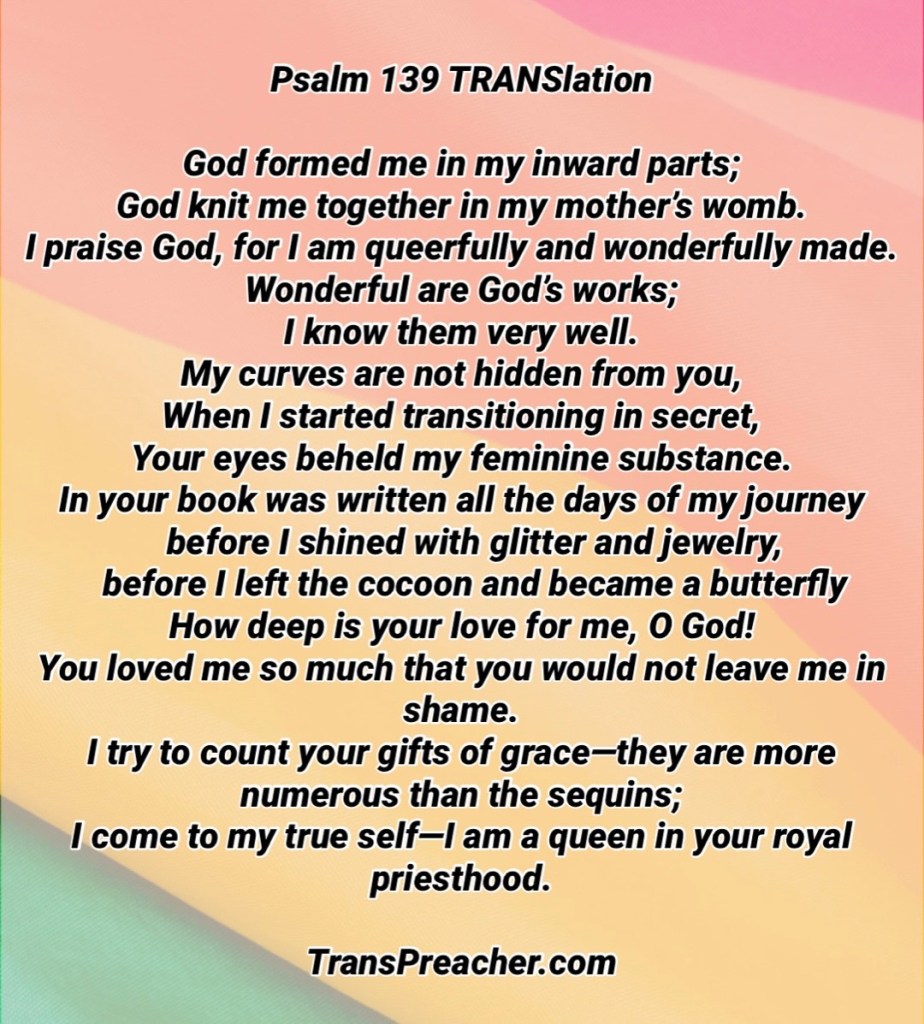
If you only remember one thing I say today, remember this: you are queerfully and wonderfully made.
You are God’s royal priesthood
You are more than tolerated by God, you are celebrated.
You are the very people God loves to use.
The Bible is filled with the stories of people who defied the norms of gender expression and sexual orientation.
When God was forming a people, he called a person named Jacob. Jacob’s older brother was Esau and Esau was the man’s man. Hairy. A hunter. A warrior.
But God did not choose to form a people through the masculine big brother, but through Jacob. Jacob who stayed in the kitchen with his mom when his brother went off to war. Jacob who did not fit masculine stereotypes.
Jacob who spent the night wrestling with another man until he was wounded and transformed and given a new name, Israel. Israel, the namesake of a people, did not fit gender norms.
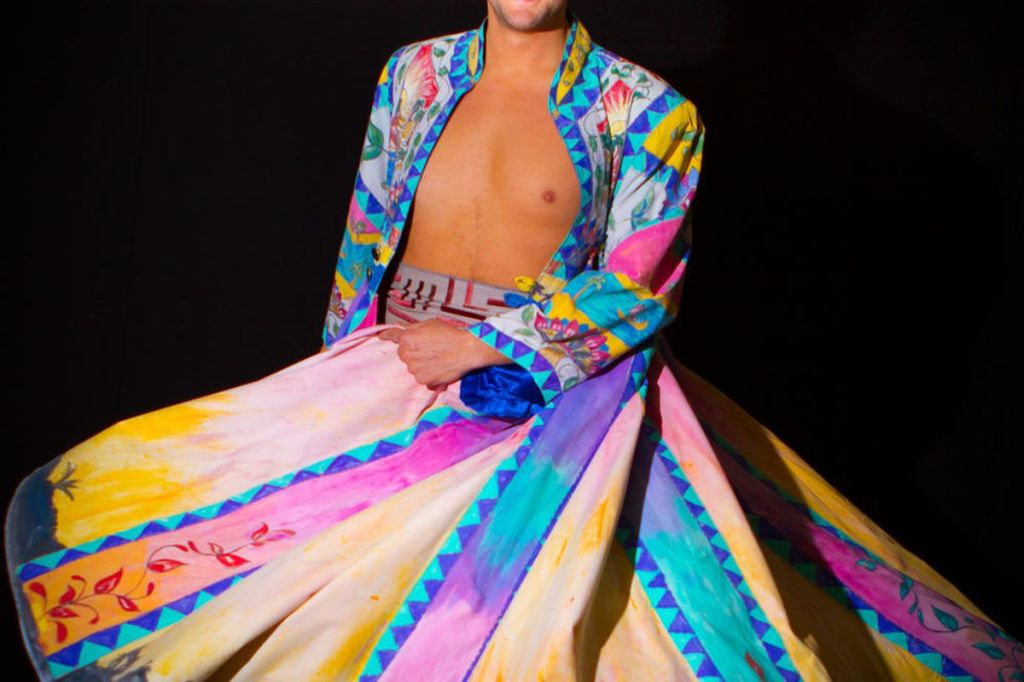
Jacob had a son named Joseph. Joseph was also not as masculine as his brothers. Joseph who was a dreamer. You have probably heard of Jacob giving Joseph a multi-colored coat, Joseph and the technicolor dreamcoat. But in the Hebrew, the word for what Jacob gives Joseph is not a coat but a princess dress. It is when Joseph shows up decked out in a princess dress that his brothers throw him in a pit and sell him in to slavery. But it is the younger brother in the princess dress who God uses to save all of them from famine.
David, the architect of Jerusalem, says of Jonathan, “Your love to me was wonderful, surpassing the love of women.”
Ruth declares to Naomi: “Where you go, I will go… your people shall be my people.” Illustrating the beauty and strength of chosen family.
In Acts, Chapter 8, the first baptized gentile is an Ethiopian Eunuch–a gender-diverse person of color who asks, “What is to prevent me from being baptized?”
Nothing.
And no matter who you love, how you love, or how you live out your gender, there is nothing to prevent you not only from receiving God’s grace, but from being God’s grace.
God loves using people who the world calls strange. Throughout the Bible God uses people who are too old and too young and labeled unclean.
And that didn’t end with the Bible.
The most impactful book I have read that shaped my understanding of God is Howard Thurman’s “Jesus of the disinherited”. Thurman, who was Dr Martin Luther King’s mentor, located Jesus amongst “the poor, the disinherited, the dispossessed.” The people who “live with their backs constantly against the wall.”

Today, we are the ones with our backs against the wall. So far this year, 940 anti-trans laws have been proposed in 49 states across our country.
Our backs are against the wall.
But that makes us the very people who God loves to use. Throughout scripture God uses the disinherited to bring liberation, transformation, and freedom.
God did the same in the civil rights movements that was led by the children of sharecroppers.
And God is doing the same with us.
My gender transition has not been just for me. I serve a church called the Church for All People, and my presence has led our church to more fully understand who all people includes.
God is doing a new thing through transgender people. God is inviting all of us to see that the diversity we see everywhere in nature is also seen in humanity. God didn’t only create light and dark, God created dawn and dusk. God didn’t only create he and she, God created they and them.
God is inviting us, as people of faith, to expand our understanding of who the neighbor is that we are called to love. Our neighbor isn’t only the person who loves and lives like us, but the person who loves and lives different from us.
Anytime God is doing a new thing, there will be people who push back. Religion will push back. Government will push back. Society will push back.
But the Holy Spirit is a relentless trouble maker.
God loves us too much to leave any of us in our shame.
God is not going to rest until all people are seen as beloved.
And God is using you, and this church, to be that grace in the world today.
You are the royal priesthood.
You are a witness to a God who colors with a broad brush.
You are queerfully and wonderfully made.
Amen
 transpreacher.com
Leave a comment